The missing piece in your design career
Why passion, skill, and money aren’t enough.
By Daniel Burka

Every few months, someone in my LinkedIn network proudly announces they’ve left the tech world behind. They’re excited about a new life as a potter, or they plan to surf in Costa Rica for the next few years.
Don’t get me wrong, part of me is genuinely happy for them. But I also feel a twinge of disappointment. Another highly skilled person, someone who benefited from decades of strong tech salaries and opportunities, is checking out of the field for good. They often express relief at leaving the corporate grind.
It may be a bit cliché, but the Japanese concept of ikigai — often translated as “reason for being” — helps explain why so many senior technologists feel unfulfilled and burned out, despite all the objectively great parts of a tech career.
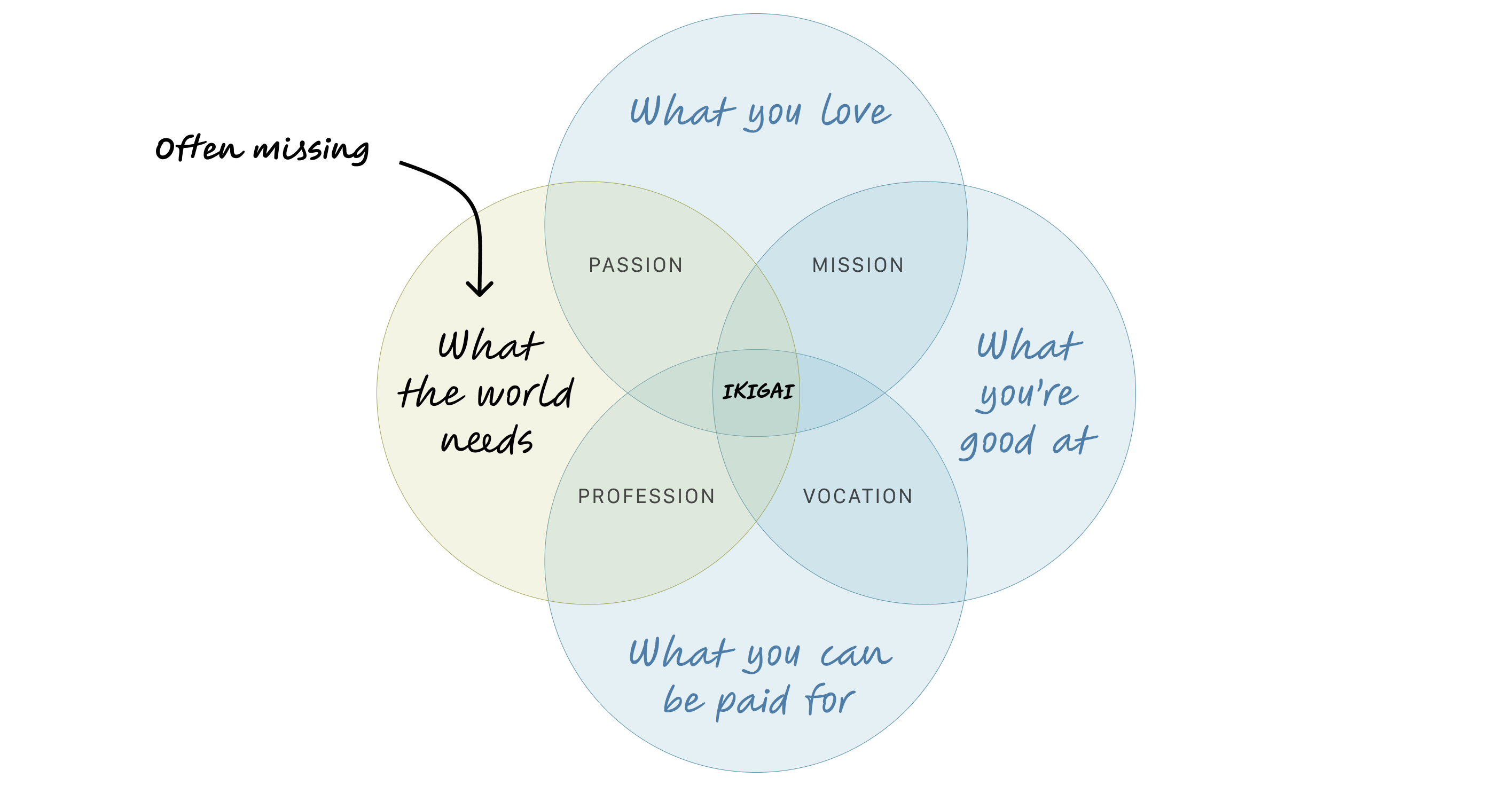
If you look at the classic Ikigai Venn diagram, many people in tech have nailed three of the four circles. A lot of us discovered “what you love” early in our lives, and it turned out to align nicely with “what you are good at.” Then we lucked out that tech pays extremely well, too. We love the work, we’re good at it, and we’re paid top dollar. Sounds perfect.
The missing piece is often the hardest one: “what the world needs.” It’s increasingly difficult to convince ourselves that much of what we’re building actually makes the world better. Most of what we’re tasked with primarily helps a few corporate leaders to make a lot of money — and in some cases, it may even be doing net harm to the world. That realization is hard to sit with.
I don’t blame anyone for throwing up their hands and choosing to go surfing in Costa Rica. But there is another path. It’s possible to apply your tech skills to problems that satisfy the fourth quadrant of ikigai: things the world genuinely needs. You’ll probably have to trade off some $$$, but you may finally find the balance that’s been missing from your career.
I can’t promise it will be easy, but at least you’ll know why you get out of bed in the morning to go to work.
If you’re looking for your next career move, maybe we can help. At Hard Problems we made some resources to help:
- Job board with great career options for you
- “Job Rank” framework you might find useful for choosing your next career move
- Tips for using LinkedIn to find your next role
I can also recommend a few books. I think Moral Ambition makes a strong case for why you should dedicate your life to a larger purpose. 80,000 Hours will give you a good framework for deciding where to apply your skills (though don’t get too drawn in by some of their arguments about money), and Geek Heresy provides a sensible foundation for thinking what tech can and can’t do to make the world better.
I truly hope you make the jump.
Daniel Burka, Co-founder of Hard Problems